

Water Leaks

Stop leaks, save water!
Leaks waste water and can cost you money. Here's how to find leaks early and get help with repairs.
Report a Water Leak
- Check our Leak Response Map to see if the leak has already been reported. No action is needed if you find it there.
- If the leak is not on the map, call Austin Water Dispatch at 512-972-1000, available 24/7.
Austin Water is responsible for maintaining and repairing water mains throughout our service area. Property owners are responsible for service lines past the meter and for internal plumbing issues.
Report a Non-Emergency Water Issue
For non-emergency issues such as bees in water meters, water taste or odor concerns, sewer odors or manhole problems, contact 3-1-1, available 24/7.
- Call 3-1-1 or 512-974-2000
- Use the 3-1-1 mobile app
- Submit a 3-1-1 Service Request
Issues submitted to 3-1-1 will be investigated within 1 to 3 business days. You can also check the status of any 3-1-1 Service Request.
If you live in an apartment complex, contact your building's maintenance team to resolve your issue.
Detect Leaks at Your Property
Start by checking your water meter and utility bill for signs of unusual use. Sign up for the My ATX Water Customer Portal to receive continuous usage alerts that could point to a leak, along with notifications when your water use increases or approaches the next billing tier.
- How to Locate Your Water Meter
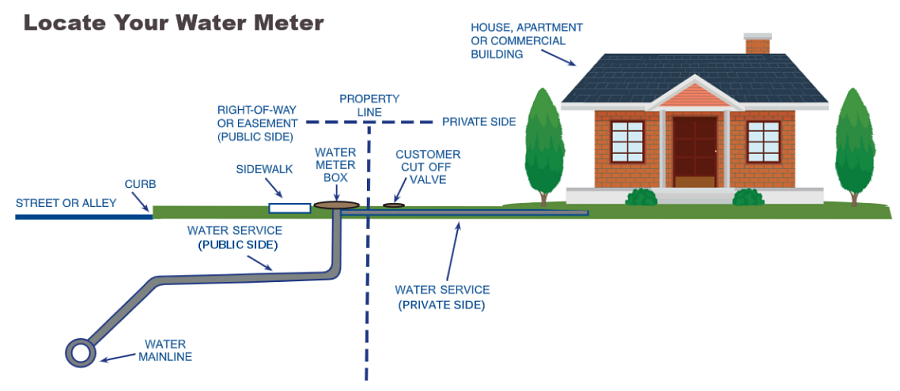
How to read this diagram
This diagram shows a cross-section of a typical property, viewed from the side, spanning from the street on the left to a house or building on the right. It illustrates how water moves from Austin Water's distribution system into your property, and identifies which parts of that system Austin Water owns and maintains versus which parts are your responsibility.
From the street to your meter
Underground in the street or alley, a water mainline carries water throughout the distribution system. A smaller pipe called the water service line branches off the mainline and runs toward your property. This public-side service line travels under the curb, through the right-of-way or public easement — the strip of land between the street and your property line — and beneath the sidewalk. Austin Water owns and maintains everything along this stretch.
Near the sidewalk, just before the property line, a water meter box is installed at ground level. This small underground enclosure houses your water meter, which measures all water entering your property.
From your meter to your building
Just past the property line on the private side, a customer cut-off valve is installed on the service line. This valve allows you to shut off water flow to your entire property in an emergency or for repairs. The private-side service line then continues from the valve to your house, apartment, or commercial building. You are responsible for maintaining the service line and cut-off valve on the private side of the meter.
You can also review your utility bill (PDF) and compare current water use to the same months of previous years. Unusually high use may indicate a leak. To check your meter directly, write down a reading and check it again a few hours later without using any water in between.
- Indoor Leaks
- Toilets — A leaky toilet can waste about 200 gallons of water every day. Add several drops of food coloring to the tank. If color appears in the bowl within 30 minutes without flushing, you have a leak.
- Faucets and showerheads — A slow drip can waste as much as 20 gallons a day. Check all faucets and showerheads for drips and repair them promptly. Austin Water offers free conservation tools including water-efficient showerheads and faucet aerators.
- Washing machine and dishwasher — Look for water on the floor near these appliances.
- Water heater — Water dripping down the side of the tank may mean the pressure relief valve is stuck.
- Outdoor Leaks
- Irrigation system — Check for damage before turning your system on each spring and after mowing.
- Soggy spots — Soft or soggy areas in your yard or uneven plant growth may indicate a leak in underground pipes.
- Home foundation — Standing water around the foundation could mean underground pipes are damaged.
- Algae buildup — Algae on the ground or walls near an outdoor spigot may be a sign of an undetected leak.
- Pool levels — Mark the desired water level with a grease pencil and check for a drop of 6 inches or more per month, which typically indicates a leak. Also check the area around the water pump.
- How Austin Water Responds to Leak Reports
We respond to leak reports quickly and with as few disruptions as possible.
- Investigation — An Austin Water technician confirms the leak's location, size and severity, then routes crews to make the repair.
- Repairs — Austin Water crews are on standby 24/7 to repair leaks and broken water lines. Waterline repairs often require traffic control and roadway repair. We coordinate with Austin Transportation and Public Works as needed.
- Road and sidewalk repairs — When repairs affect a roadway, sidewalk, curb, gutter or driveway, Austin Water makes temporary repairs and submits a request to the Street and Bridge Division of Austin Transportation and Public Works for permanent repairs.
- Plumbing Repair Assistance
The City of Austin Housing Department's Plumbing Repair Program helps qualifying households fix plumbing issues related to public health, safety and water savings — including toilets, showers, sinks and faucets — at no cost. The City can provide up to $15,000 in grant funds for eligible home repairs.
- Water Outages
Austin Water crews perform routine maintenance including valve exercises, pressure and flow testing and leak detection that may require temporary water shutoffs. Connections related to new development may also require brief shutoffs. View current and planned outages on the Water Outage and Leak Response Map.
- Bill Adjustments
If a leak resulted in a higher bill than usual, you may be eligible for a water leak bill adjustment.