

Water Quality Reports

Austin Water tests your drinking water multiple times a day, every day, to ensure it meets and exceeds state and federal safety standards.
Austin Water’s annual Consumer Confidence Report describes the overall quality of your water from raw collection and storage to treated water at your tap. The U.S. Environmental Protection Agency (EPA) requires all drinking water suppliers to provide this report to customers each year. This page explains where your water comes from, how we treat and test it, what we found in 2025 and how to stay informed about your water quality.
Para asistencia en español, por favor llame al 512-972-0155.
Some people may be more vulnerable than the general population to certain contaminants in drinking water. Infants, some elderly or immunocompromised persons such as those undergoing chemotherapy; those who have undergone organ transplants; and people with HIV/AIDS or other immune system disorders can be particularly at risk from infections. These people should seek advice about drinking water from their health care provider. Additional guidelines on appropriate means to lessen the risk of infection by Cryptosporidium are available from the Safe Drinking Water Hotline at 800-426-4791.
Where Your Drinking Water Comes From
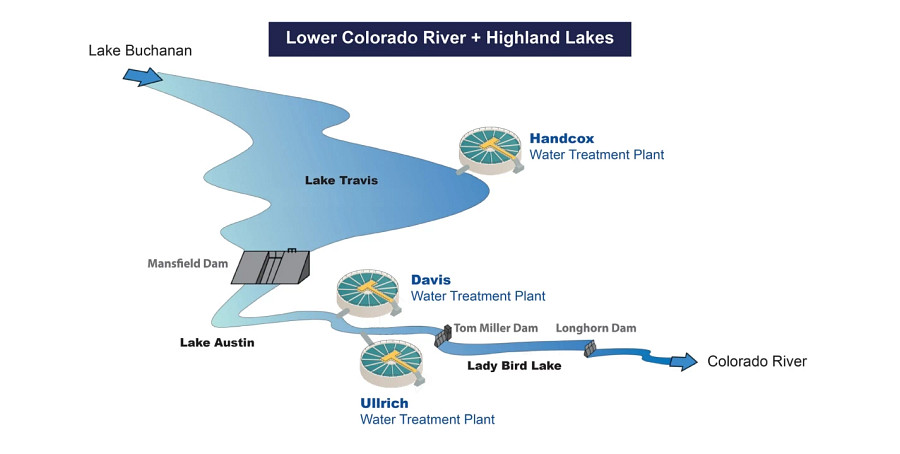
Austin Water draws surface water from the Lower Colorado River as it flows through Lake Travis and Lake Austin. We treat this water at the Handcox, Davis and Ullrich water treatment plants to a standard that exceeds what federal and state law requires.
We Protect the Source
The Texas Commission on Environmental Quality (TCEQ) completed an assessment of our source water, and results indicate that some of our sources are susceptible to certain contaminants. Sampling requirements for our water system are based on this susceptibility and previous sample data. Any detection of these contaminants will be noted in our Consumer Confidence Report. For more information on source water assessments and protection efforts, contact Austin Water’s Water Quality Manager at 512-972-0012.

What's in Your Drinking Water?
The sources of drinking water nationwide (both tap water and bottled water) include rivers, lakes, streams, ponds, reservoirs, springs and wells. As water travels over the surface of the land or through the ground, it dissolves naturally occurring minerals and, in some cases, radioactive material, and can be polluted by animals or human activity. Contaminants that may be present in the source water include:
- Microbial contaminants, such as viruses and bacteria, which may come from wastewater treatment plants, septic systems, agricultural livestock operations and wildlife.
- Inorganic contaminants, such as salts and metals, which can be naturally occurring or result from urban storm water runoff, industrial or domestic wastewater discharges, oil and gas production, mining or farming.
- Pesticides and herbicides, which may come from a variety of sources such as agriculture, storm water runoff and residential uses.
- Organic chemicals, including synthetic and volatile organic chemicals, which are byproducts of industrial processes and petroleum production and can also come from gas stations, urban storm water runoff and septic systems.
- Radioactive contaminants, which can be naturally occurring or the result of oil and gas production and mining activities.
In order to ensure that tap water is safe to drink, the EPA prescribes regulations which limit amounts of certain contaminants in water provided by public water systems. The Food and Drug Administration regulations establish limits for contaminants in bottled water which must provide the same protection for public health.
Contaminants may be found in drinking water that may cause taste, color or odor problems. These types of problems are not necessarily a cause for health concerns. For more information on taste, odor or color of drinking water, contact Austin Water at 512-972-0012.
Drinking water, including bottled water, may reasonably be expected to contain at least small amounts of some contaminants. The presence of contaminants does not necessarily indicate that the water poses a health risk. More information about contaminants and potential health effects can be obtained by calling the EPA’s Safe Drinking Water Hotline at 800-426-4791.
2025 Consumer Confidence Report
Visit our monthly and quarterly water quality summaries for the most current results including total hardness, pH, total dissolved solids and more.
Sampled in 2025 unless noted differently. Austin Water Public Water System ID: 2270001.
Regulated at the Treatment Plant
| Substance | Highest Level Allowed (EPA's MCL) | Low | High | Average | Ideal Goals (EPA's MCLG) | Possible Sources |
|---|---|---|---|---|---|---|
| Barium (ppm) | 2 | 0.009 | 0.015 | 0.012 | 2 | Discharge of drilling wastes; discharge from metal refineries; erosion of natural deposits |
| Beta/photon emitters (pCi/L) 2024* | 50 | 4.5 | 4.5 | 4.5 | 0 | Decay of natural and human-made deposits may release photon and beta radiation |
| Cyanide (ppb) | 200 | 10 | 80 | 50 | 200 | Discharge from steel/metal factories; discharge from plastic and fertilizer factories |
| Fluoride (ppm) | 4 | 0.59 | 0.71 | 0.66 | 4 | Water additive which promotes strong teeth; erosion of natural deposits; discharge from fertilizer and aluminum factories |
| Nitrate (as Nitrogen) (ppm) | 10 | 0 | 0.11 | 0.05 | 10 | Runoff from fertilizer use; leaching from septic tanks, sewage; erosion of natural deposits |
| Simazine (ppb) 2024 | 4 | 0 | 0.08 | 0.03 | 4 | Herbicide runoff |
| Total Organic Carbon (TOC) Removal Ratio** | TT — Annual average ≥ 1 | 1.00 | 1.75 | 1.27 | Not applicable | Naturally present in the environment |
| Turbidity (NTU) | TT — 95% of monthly samples must be ≤ 0.3 NTU and no sample can be > 1 NTU | 0.02 | 0.11 — 100% of samples ≤ 0.3 | 0.04 | Not applicable | Turbidity is a measure of water cloudiness, typically due to soil runoff |
* EPA considers 50 pCi/L to be the level of concern for beta particles.
** The TOC removal ratio is calculated on a monthly basis and is the percent of TOC removed through the treatment process divided by the percent of TOC removal required by TCEQ.
Regulated in the Distribution System
| Substance | Highest Level Allowed (EPA's MCL) | Low | High | Average | Highest LRAA | Ideal Goals (EPA's MCLG) | Possible Sources |
|---|---|---|---|---|---|---|---|
| Chloramines (ppm) | 4 (MRDL) | 0.06 | 3.1 | 2.3 | Not applicable | ≤4 (MRDLG) | Disinfectant used to control microbes |
| Haloacetic Acids (HAA5) (ppb) | Yearly Average (LRAA) 60 | 8.4 | 21.1 | 13.1 | 15.6 | Not applicable | Byproduct of drinking water disinfection |
| Total Trihalomethanes (TTHM) (ppb) | Yearly Average (LRAA) 80 | 31.4 | 53.9 | 40.5 | 45.5 | Not applicable | Byproduct of drinking water disinfection |
In addition to routine monitoring, Austin Water tests locations across our distribution system more than 300 times per month for the presence of E. coli bacteria. No samples tested positive for E. coli in 2025. Austin Water was not required to conduct a Level 1 or Level 2 Assessment under EPA or state regulations.
Lead and Copper Rule
| Substance | Action Level (AL) | Low | High | Average | Results | Ideal Goals (EPA's MCLG) | Possible Sources |
|---|---|---|---|---|---|---|---|
| Copper (ppm) 2024 | AL = 1.3 | 0 | 0.01 | 0.003 | 90% of all samples tested were <0.008 ppm. None exceeded 1.3 | 1.3 | Corrosion of household plumbing systems; erosion of natural deposits |
| Lead (ppb) 2024 | AL = 15 | 0 | 5.1 | 0.2 | 90% of all samples tested were <1.0 ppb. No sample exceeded 15 | 0 | Corrosion of household plumbing systems; erosion of natural deposits |
Testing is conducted at customer taps every three years. Complete lead tap sampling data are available for review by calling 512-972-2133.
Hardness
| Substance | Highest Level Allowed (EPA's MCL) | Low | High | Average | Ideal Goals (EPA's MCLG) | Possible Sources |
|---|---|---|---|---|---|---|
| Total Hardness (as CaCO3) (ppm) [gpg] | Not applicable | 70 [4.1] | 126 [7.4] | 93 [5.4] | Not applicable | Water hardness is the measure of dissolved calcium and magnesium from the erosion of natural deposits |
Unregulated Contaminants
| Substance | Highest Level Allowed (EPA's MCL) | Low | High | Average | Ideal Goals (EPA's MCLG) | Possible Sources |
|---|---|---|---|---|---|---|
| Bromodichloromethane (ppb) | Not regulated individually | 9.6 | 18.5 | 13.7 | 0 | Byproduct of drinking water disinfection |
| Dibromochloromethane (ppb) | Not regulated individually | 5.7 | 15.2 | 10.3 | 60 | Byproduct of drinking water disinfection |
| Chloroform (ppb) | Not regulated individually | 6.6 | 27.3 | 14.1 | 70 | Byproduct of drinking water disinfection |
| Bromoform (ppb) | Not regulated individually | 0 | 3.7 | 1.7 | 0 | Byproduct of drinking water disinfection |
Unregulated contaminants are those for which EPA has not established drinking water standards. The purpose of unregulated contaminant monitoring is to assist EPA in determining the occurrence of unregulated contaminants in drinking water and whether future regulation is warranted. For additional information, visit epa.gov or call the Safe Drinking Water Hotline at 800-426-4791.
Table Key
| Term | Definition |
|---|---|
| AL — Action Level | The concentration of a contaminant which, if exceeded, triggers treatment or other requirements which a water system must follow |
| Level 1 Assessment | A study of the water system to identify potential problems and determine (if possible) why total coliform bacteria were found |
| Level 2 Assessment | A detailed study of the water system to identify potential problems and determine (if possible) why an E. coli MCL violation has occurred and/or why total coliform bacteria were found on multiple occasions |
| TT — Treatment Technique | A required process intended to reduce the level of a contaminant in drinking water |
| MCL — Maximum Contaminant Level | The highest level of a contaminant allowed in drinking water. MCLs are set as close to the MCLGs as feasible using the best treatment technology |
| MCLG — Maximum Contaminant Level Goal | The level of a contaminant in drinking water below which there is no known or expected risk to health. MCLGs allow for a margin of safety |
| MRDL — Maximum Residual Disinfectant Level | The highest level of a disinfectant allowed in drinking water. There is evidence that addition of a disinfectant is necessary for control of microbial contaminants |
| MRDLG — Maximum Residual Disinfectant Level Goal | The level of a drinking water disinfectant below which there is no known or expected risk to health. MRDLGs do not reflect the benefits of the use of disinfectants to control microbial contaminants |
| LRAA — Locational Running Annual Average | The average of sample results taken at a specific monitoring location during the previous four calendar quarters |
| NTU — Nephelometric Turbidity Units | A measure of turbidity |
| pCi/L — picocuries per liter | A measure of radioactivity |
| ppm — parts per million | Milligrams per liter (mg/L) |
| ppb — parts per billion | Micrograms per liter (µg/L) |
| ppt — parts per trillion | Nanograms per liter (ng/L) |
| gpg — grains per gallon | Standard unit used to program household water appliances. One grain of calcium carbonate dissolved in one U.S. gallon equals approximately 17.1 ppm |
- Continuous Sampling and Testing
Austin Water collects samples at our treatment plants and across our water system multiple times a day, every day, to test for bacteria and chemicals that could pose a risk to our customers. Our top priority is to ensure your water is safe and satisfying to drink.
Protecting Vital Infrastructure- Following the devastating impacts of Winter Storm Uri in 2021, Austin Water’s infrastructure was repaired and winterized to better withstand future extreme freezing weather events.
- A copper sulfate feed system was installed in 2020 to protect raw water piping against zebra mussels that can damage equipment and affect taste and odor in drinking water.
- In October 2025, Austin Water conducted a preparedness training exercise near the Ullrich Water Treatment Plant on Lake Austin. The exercise simulated an oil spill approaching the plant’s raw water intakes near Tom Miller Dam, and included emergency response watercraft and personnel from Austin Watershed Protection, the Lower Colorado River Authority and TCEQ. Participants practiced coordinated emergency response procedures including tracking simulated contaminant flows, deploying floating booms and containment barriers and conducting spill recovery operations. The exercise builds on recommendations from the External Review of Austin Water Quality Events conducted by The University of Texas Center for Water and the Environment.
Treatment Reliability
Austin Water sets treatment goals and quality standards that go beyond minimum state and federal requirements. TCEQ requires treated water clarity (turbidity) of 0.3 NTU or less. Austin Water’s goal is 0.1 NTU or lower, and we consistently achieve this standard.
A polymer feed system installed in 2020 strengthens our ability to manage flooding impacts and improve filter performance, particularly during high turbidity events. Polymer systems are fully operational across all three water treatment plants.
Powdered activated carbon is added during treatment to minimize taste and odor issues.
Licensed plant operators conduct water testing at least every two hours during multiple phases of the treatment process every day, checking disinfectant residual, turbidity, pH, alkalinity and water softening levels. On-line equipment continuously monitors treatment performance in real time.
Quality Control in Storage and Distribution
Water storage tanks are routinely tested for bacteriological contaminants to ensure water remains at the same quality as when it left the treatment plant.
Water quality instrumentation is installed and maintained in every major pressure zone to provide real-time monitoring throughout the distribution system.
Replacement of polybutylene service water lines was completed in 60 subdivisions as part of a capital improvement project to reduce line breaks and minimize the risk of contaminant infiltration.
Last year, Austin Water was honored to be inducted into the Leading Utilities of the World, a global network of the most forward-thinking water and wastewater utilities. Membership represents the gold standard for innovation and performance across the developed world’s water sector. To qualify for membership, utilities must demonstrate outstanding innovation across 14 distinct areas, including advances in drinking water treatment systems, improvements to potable water quality, and the development of creative methods for obtaining high-quality measurements.
Finished Drinking Water Testing- For public safety and to ensure Austin Water customers receive fresh water, annual maintenance is conducted on every fire hydrant in the city.
- In addition to daily testing at each water treatment plant, more than 300 water samples are collected each month to test for bacteriological contaminants, total chlorine residual levels and other important parameters throughout the water distribution system.
- Austin Water monitored for per- and polyfluoroalkyl substances (PFAS), some of which will soon be regulated. Austin Water’s results revealed little to no detectable traces of PFAS in the City’s drinking water. For more information on PFAS and sample results, visit our PFAS webpage.
In 2025, Austin Water completed a pilot project that enhances and strengthens our water sampling program and has received final approval for wider implementation. The program includes sampling stations installed within select water meter boxes, providing water quality scientists with convenient access points for rapid water testing.
- Monitoring for Health Risks
Cryptosporidium
Cryptosporidium is a parasite that can create an infection called gastroenteritis. Infection from Cryptosporidium organisms can occur in humans and animals and is spread by contact with soil, water, food or surfaces that have been contaminated. Austin Water monitors our lakes for Cryptosporidium because surface water sources are known to be susceptible to this contaminant.
During the 2025 monitoring for Cryptosporidium, Austin Water collected 12 samples. All samples reported no detection. The treatment processes employed at Austin Water’s treatment plants are effective for removal of Cryptosporidium.
Harmful Algal BloomsCyanobacteria, also called blue-green algae, are microscopic organisms found naturally in surface waters. These organisms use sunlight to make their own food. In warm, nutrient rich waters, cyanobacteria can multiply quickly, creating algal blooms that spread across the water’s surface.
Some algae may produce cyanotoxins which can be harmful to humans and animals. Since 1992, Austin Water has monitored source water and drinking water for the presence of cyanobacteria. In 2015, Austin Water also began monitoring for the presence of cyanotoxins. We conduct routine testing for the presence of cyanotoxins in Lake Austin and Lake Travis, as well as in water that has finished the treatment process at the Handcox, Davis and Ullrich Treatment Plants. Testing for the presence of cyanobacteria and other microscopic algae in raw lake water is conducted at least weekly, and cyanotoxin testing is performed on a routine basis. Sampling frequency is adjusted based on changing conditions.
In addition, to protect public health and safety, Austin Water has invested in leading-edge technology to shorten the time it takes to receive test results. Employing digital imaging particle analysis and same-day testing, we are able to detect harmful algae quicker than before. We also meet regularly with our counterparts at Austin Watershed Protection and the Lower Colorado River Authority to review and report on our respective testing and mitigation approaches.
Austin Water performs several treatment techniques at our water plants to effectively and efficiently remove cyanobacteria and cyanotoxins. The harmful cells containing the toxins can be physically removed through the coagulation, flocculation, sedimentation and filtration process. Chlorine, which is part of the plant’s disinfection process, is destructive to cyanotoxins. Finally, the powdered activated carbon that is used to remove taste and odor causing compounds also removes cyanotoxins.
- Keeping the Lead Out
Austin Water Confirms No Lead Pipes in the System
After completing a comprehensive, multi-year inventory of all public water service lines, Austin Water confirmed in October 2024 that Austin’s public water system is free of lead pipes. Lead has not been permitted in public pipeline infrastructure since the 1950s. Austin Water has removed preexisting lead lines during normal maintenance and water line rehabilitation since the 1960s.
Austin Water’s lime softening process helps coat pipes and prevent corrosion that could leach lead into drinking water, even on the private side of the meter.
A small number of service lines in Austin Water’s service area have been identified as Galvanized Requiring Replacement (GRR) — galvanized iron or steel pipe between the meter and the building with unclear history. These pipes could have absorbed lead if they were ever downstream of a lead pipe. Property owners with GRR service lines have been notified and may sign up to have their service line replaced at no cost.
For information on the service line materials inventory, visit our lead pipe information page or Water Service Line Material Inventory Web Map. Austin Water also encourages schools and licensed daycares to enroll in the TCEQ free voluntary testing program for free lead testing and filters where lead is found.
Check Your Plumbing for LeadCommon sources of lead in drinking water include lead pipes, solder and brass plumbing components such as faucets, fixtures and pipe fittings. Homes built before 1986 — when federal rules began requiring lead-free pipes and solder — may be at higher risk. Fittings and fixtures were not fully covered by lead-free standards until 2014.
Lead can cause serious health problems, especially for pregnant women and young children. Lead in drinking water is primarily from materials and components associated with service lines and home plumbing. Austin Water is responsible for providing high quality drinking water and removing lead pipes but cannot control the variety of materials used in plumbing components in your home.
You share the responsibility for protecting yourself and your family from the lead in your home plumbing. Take steps to identify and remove lead materials from your home plumbing.
Use only cold water for drinking, cooking and making baby formula. Boiling water does not remove lead.
Before using tap water for drinking or cooking, flush your pipes for several minutes by running your tap, taking a shower or running a load of laundry or dishes.
Use a filter certified by an American National Standards Institute accredited certifier to reduce lead. Follow the filter instructions to ensure proper use.
If you are concerned about lead in your water and wish to have your water tested, contact Austin Water at 512-972-2133.
For more information on lead in drinking water, testing methods and steps to minimize exposure, visit epa.gov/safewater/lead.
- Fluoride
Austin Water began adding fluoride to drinking water on Feb. 2, 1973, following a community referendum in the early 1970s. Fluoride was first added to municipal drinking water in 1945 to fight tooth decay, with follow-up studies showing a 50% to 70% reduction in cavities over 13 to 15 years.
On Dec. 15, 2011, Austin City Council voted to continue fluoridating in accordance with public health recommendations from the Centers for Disease Control and the City’s Health and Human Services Department. Austin Water must follow current fluoridation policies until they are changed or no longer in place.
Austin Water’s fluoridation practices follow guidance from the American Water Works Association (AWWA), which supports recommendations from the World Health Organization, American Medical Association, American Academy of Pediatrics, Centers for Disease Control, American Dental Association and other leading health organizations.
Fluoride and InfantsWater fluoridated at a level optimal for oral health poses no known health risks for infants. However, some children may develop enamel fluorosis, a cosmetic condition where faint white markings or streaks may appear on teeth. To minimize your baby’s exposure, you can breastfeed, use ready-to-feed formula or alternate tap water with non-fluoridated water when preparing infant formula. If you use only non-fluoridated water such as purified, deionized or distilled water to prepare formula, your doctor may recommend fluoride supplements.
- A Whole-System Commitment to Efficiency and Conservation
Improving water system efficiency requires coordinated action across plants, transmission mains and service lines, as well as deployment of leak detection technologies and fine-tuning of repair and replacement processes.
Capital investments and infrastructure renewal — Through the Renewing Austin program, aging infrastructure is being repaired and replaced to reduce leaks and improve reliability. Austin Water will invest $18 million over the next five years to replace service lines that are prone to breaks and require frequent repairs.
Leak detection — Advanced monitoring technologies are being piloted to identify leaks early, before they are visible above ground. Meters with acoustic technology and data loggers are deployed in neighborhoods with a higher number of breaks. Free-swimming acoustic sensors travel long stretches of large-diameter waterlines to pinpoint very small leaks. More than 750 miles of the water distribution system were canvassed in 2025 to identify leaks.
Rapid leak response — Austin Water strives to deploy crews, evaluate the leak and initiate repairs or replacement within three hours of receiving a call about a potential leak. Over the last two years, more than 700 water lines that were reported leaking were replaced rather than repaired, quickly addressing failing lines as they are identified.
In 2025, Austin Water completed a comprehensive and multi-year effort to modernize Austin’s metering infrastructure by replacing 250,000 outdated analog water meters with modern digital meters capable of transmitting real-time water usage data. The system improvements strengthen Austin’s metering system, reduce labor costs associated with manual meter reading, decrease data errors, and improve billing accuracy. The system also improves customer service by allowing customers to monitor their own water use via a data portal, receive custom notifications and alerts about potential leaks.
- Water Loss
Infrastructure Leak Index
Water utilities measure system efficiency using the Infrastructure Leak Index (ILI), a standard developed by the American Water Works Association and the Texas Water Development Board. ILI evaluates how effectively a utility delivers potable water while minimizing losses. For a system the size of Austin’s, an ILI between 3 and 5 is considered appropriate. Lower values indicate higher efficiency with less water lost to leaks.
From 2024 to 2025, Austin Water reduced water loss by 5%:
2025 ILI: 5.16
2024 ILI: 5.44
ILI measures water loss relative to the size and complexity of a utility system, accounting for the number of service connections and miles of water mains. Because it reflects system characteristics rather than population or total water use, ILI provides a consistent way to compare performance across utilities.
For more information, contact Austin Water at 512-972-1000 or visit the Managing Water Loss section of the System Maintenance page.
- Current Results and Archived Reports
Visit our monthly and quarterly water quality summaries page for the most current results including total hardness, pH, total dissolved solids and more.
Annual water quality reports from previous years:
Stay Informed
There are many opportunities to learn more about Austin’s water quality and get involved in decisions that affect your water.
- Attend an Austin City Council or Water and Wastewater Commission meeting to provide public input on water quality issues.
- Follow Austin Water on Facebook, X and Instagram for water quality updates, conservation tips, landscaping advice and cold weather pipe protection information.
- Contact Austin Water's Water Quality Manager at 512-972-0012 with questions about source water assessments or water quality concerns.