Right-of-Way Management
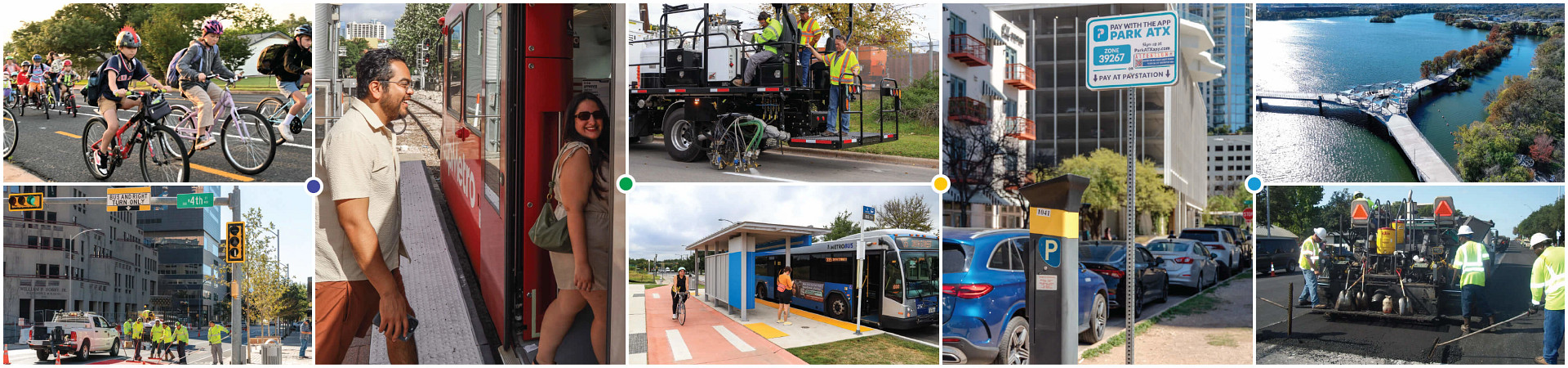
The Right-of-Way (ROW) Management team verifies that ROW activities comply with federal, state and local standards. The team makes sure traffic can move safely through and around these activities.
Staff members are available for walk-in services Monday through Friday, 7:45 a.m. to 4:45 p.m. at the Austin Permitting and Development Center. If you have specific needs, we encourage you to schedule an appointment to ensure the appropriate subject matter expert is available to assist you.
Contact Right-of-Way Management
Phone: 512-974-7828
Email: RightOfWay@austintexas.gov
Austin Permitting and Development Center
6310 Wilhelmina Delco Dr
Austin, TX 78752
This list includes all known current and expected full-road closures implemented or proposed on major roadways (levels 3 and above as categorized by the Austin Strategic Mobility Plan) throughout the City of Austin’s right-of-way.
Permits for dumpsters, temporary ROW use, sidewalk cafés, driveways/sidewalks, and excavation require insurance, a $10,000 bond, and a ROW Contractor License, which is obtained by submitting a bond, an insurance certificate, a resolution of authority, and an authorized agent.
The AULCC is a group of utility stakeholders. Per Ordinance 14-11-165, this group meets regularly in order to identify right-of-way utility conflicts before construction begins.
This list includes all known current and expected full-road closures implemented or proposed on major roadways (levels 3 and above as categorized by the Austin Strategic Mobility Plan) throughout the City of Austin’s right-of-way.
Permits for dumpsters, temporary ROW use, sidewalk cafés, driveways/sidewalks, and excavation require insurance, a $10,000 bond, and a ROW Contractor License, which is obtained by submitting a bond, an insurance certificate, a resolution of authority, and an authorized agent.
The AULCC is a group of utility stakeholders. Per Ordinance 14-11-165, this group meets regularly in order to identify right-of-way utility conflicts before construction begins.
The City maintains public streets, sidewalks, alleys, trails, medians, and street trees, while property owners must keep adjacent vegetation trimmed (e.g., 8 ft over sidewalks, 14 ft over streets, grass ≤12 in) and clear obstacles like cars, carts, and scooters to ensure safe, accessible passage.
Any work in the public right of way—such as driveway/sidewalk, excavation, parking, sidewalk cafés, valet/vendor, or temporary use—requires determining permit type, securing pre‑approvals (e.g., traffic plans), online application, stakeholder coordination, fee payment, and possible extensions or revisions.
Austin Build + Connect (AB+C) is the City's online portal that allows registered users to apply for permits, schedule inspections, pay fees, upload project attachments, and more.
Traffic Control
Visit the ROW Portal to submit traffic control plans, TCP Conflict Review Requests and shared TCPs.
- Guidelines for Functional Classification to Austin Strategic Mobility Plan (City of Austin)
City of Austin Standard Details:
To use of these standard details is governed by the Texas Engineering Practice Act and the latest edition of the Texas Manual Uniform of Traffic Control Devices (TMUTCD). The temporary traffic control (TTC) selected for each situation should be based on engineering judgement with consideration of issues such as type of highway, road user conditions, duration of operation, physical constraints, and the nearness of the work space to road users as per TMUTCD Section 6A.01 Paragraph 13. Any use of standard details must match existing field conditions. The following details is general guidance on what details could be allowed after the appropriate engineering judgement.
Sheets Number Title Can be applied to the following: Notes 804S-1
Sheet 1
Arterial One Lane Closure Level 3 and 4 streets 804S-1
Sheet 2
One Way Arterial Two-Lane Closure Level 3 and 4 streets Double lane closures prohibited in DAPCZ from Monday through Friday per TCM Section 8. 804S-1
Sheet 3
Two Way Divided Arterial One Lane Closure Level 3 and 4 Streets 804S-1
Sheet 4
Bypass Walkway
Sidewalk and Crosswalk Closures
All street levels - PROWAG R205 and TMUTC Section 6D.01 Paragraph 9 prioritizes maintaining pedestrian access (diversion path) on the same side of the street compared to full closure of the pedestrian path and detour across the street
- When existing pedestrian facilities are disrupted, closed or relocated in a temporary traffic control (TTC) zone, the temporary facilities shall be detectable and include accessibility features consistent with the features present in the existing pedestrian facility. Where pedestrians with visual disabilities normally use the closed sidewalk, a barrier that is detectable by a person with a visual disability traveilng with the aid of a long cane shall be placed across the full width of the closed sidewalk (TMUTCD Section 6D.02)
804S-1
Sheet 5
Collector/Residential Lane Closures REFER TO THE 804S-2 SERIES FOR FLAGGING. DO NOT USE THIS SHEET. 804S-1
Sheet 6
Typical Traffic Control Plan for Shifting Traffic Level 3 and 4 streets 804S-1
Sheet 7
Typical Traffic Control Plan for Shifting Traffic Level 3 and 4 streets 804S-1
Sheet 8 and 9
GENERAL NOTES SHALL APPLY TO ALL SHEETS 804S-1
Sheet 10
Bike Lane Closure and Bike Lane Closure with Adjacent Travel Lane REFER TO THE 804S-1B SERIES FOR BIKE LANES. DO NOT USE THIS SHEET. 804S-1
Sheet 11
Bike Lane Adjacent to Curb and Bike Lane Adjacent to Parking Lane REFER TO THE 804S-1B SERIES FOR BIKE LANES. DO NOT USE THIS SHEET. 804S-1
Sheet 12
Shared Bike Lane, Shared Bike Lane Parking Lane, Lane Channelizing into Bike Lane & Parking Lane REFER TO THE 804S-1B SERIES FOR BIKE LANES. DO NOT USE THIS SHEET. 804S-1
Sheet 13
Single Lane Closure on a Three Lane Roadway w/ Bike Lanes REFER TO THE 804S-1B SERIES FOR BIKE LANES. DO NOT USE THIS SHEET. 804S-1B
Sheet 3
STANDARD NOTES SHALL APPLY TO Sheet 4 through Sheet 7 804S-1B
Sheet 4-Sheet 7
MERGING CYCLIST STANDARD DETAILS Bike Lane Closure:
- Level 1 streets
- Level 2 streets where it is under 5,000 ADT
Cyclist merging can only occur when ALL of the following field conditions are met:
- 30 MPH or less (not 35 MPH or less as indicated on detail)
- Under 5,000 ADT
- NOT LOCATED ON AN ALL AGES AND ABILITY (AA) NETWORK BIKE FACILITY AS IDENTIFIED BY THE LATEST EDITION OF THE AUSTIN STRATEGIC MOBILITY PLAN (ASMP) OR DOES NOT IMPACT SUCH A FACILITY FOR MORE THAN 14 DAYS (2 WEEKS)
804S-1B
Sheet 3
STANDARD NOTES SHALL APPLY TO Sheet 9 through Sheet 14 804S-1B
Sheets 8, 10, 12
BICYCLE BYPASS STANDARD DETAIL (Long-Term Set up only) REQUIRES ROW ENGINEERING REVIEW BEFORE IMPLEMENTING Protected bike lanes can be used on ANY street levels 804S-1B
Sheets 9, 11, 13, 14
BICYCLE BYPASS STANDARD DETAIL (Daily Set up) CAN BE USED ON ALL STREET LEVELS Protected bike lanes can be used on ANY street levels 804S-1a
All Sheets
DO NOT USE THESE SHEETS. 804S-2
Sheet 1
Collector/Residential Street Flagging Operations DO NOT USE THIS SHEET, REFER TO 804S-2 SHEET 2 OR TxDOT STANDARD DETAIL TCP (1-2)-18 ONE-LANE TWO-WAY TRAFFIC CONTROL FOR "SELF-REGULATED" OR "STOP/YIELD CONTROLLED" WORK ZONES. USE OF THESE DETAILS MUST COMPLY WITH THE TMUTCD, SUCH AS MAINTAINING CLEAR VISIBILITY, LOW-TRAFFIC VOLUMES, AND SHORT LENGTH WORK ZONES. 804S-2
Sheet 2
Flagger Setup for 2 Lane Roadway Level 1 and 2 streets 804S-2
Sheet 3
GENERAL NOTES APPLY TO ALL SHEETS. NOTE #3 IS VOID. FLAGGERS CANNOT PROVIDE CONFLICTING TRAFFIC DIRECTION TO A TRAFFIC SIGNAT AT A SIGNALIZED INTERSECTION. ONLY TRAFFIC ENFORCEMENT OFFICERS ARE AUTHORIZED TO DIRECT AT SIGNALIZED INTERSECTIONS. 804S-2
Sheet 4
Flagger Setup for Vehicles Entering and Exiting Work Site Level 1 and 2 streets Two flaggers are REQUIRED by default for this detail. It is not an option. 804S-2
Sheet 5
Street Detour Single Direction Level 1 and 2 streets (minus Critical Arterials and streets with bike lanes) Leven 3 and 4 will require ROW engineering review due to the high-volume of vehicles being detours (above 10K). Bike lane closures will require a detour. 804S-2
Sheet 6
Street Detour Both Directions Level 1 and 2 streets (minus Critical Arterials) Level 3 and 4 will require ROW engineering review due to the high volume of vehicles being detours (above 10K). 804S-2
Sheet 7 & 8
GENERAL NOTES APPLY TO ALL SHEETS 804S-3 All Sheets Temporary Traffic Control Pavement Markings All Street Levels Temporary markings longitudinal pavement markings should match existing line thickness (4"-6") 804S-4
Sheet 1 & 2
Safety Fence All Street Levels Safety fence or barricades must comply with ADA/PROWAG compliance when channelizing pedestrians 804S-4
Sheet 3
Large Excavation All Street Levels Must meet all positive protection and clear zone requirements as set in the TCM. Safety fence or barricades must comply with ADA/PROWAG compliance when channelizing pedestrians 804S-4
Sheet 4
Work Area Protection All Street Levels Must meet all positive protection, clear zone, and slope requirements (TxDOT). 804S-4
Sheet 5, 6, 7
Steel Plating Case 1 can be allowed on Level 1 Streets
Case 2 can be allowed on Level 1, 2, 3, and 4 streets
804S-4
Sheet 8 & 9
Material and Equipment Storage Must meet all positive protection and clear zone requirements as set in the TCM. Safety fence or barricades must comply with ADA/PROWAG compliance when channelizing pedestrians. - Guidelines for Functional Classification to Austin Strategic Mobility Plan (TxDOT)
TxDOT Standard Details
The use of these standard details is governed by the Texas Engineering Practice Act and the latest edition of the Texas Manual Uniform of Traffic Control Devices (TMUTCD). The temporary traffic control (TTC) selected for each situation should be based on engineering judgement with consideration of issues such as type of highway, road user conditions, duration of operation, physical constraints, and the nearness of the work space to road users as per TMUTCD Section 6A.01 Paragraph 13. Any use of standard details must match existing field conditions. The following details is general guidance on what details could be allowed after the appropriate engineering judgement.
All TxDOT notes shall apply when using these standard details. Take note regarding the work duration in order to determine if the detail is allowed.
Sheet Number Sheet Name Can be applied to the following Notes TCP(1-1)-18 Conventional Road Shoulder Work All Street Levels TCP(1-2)-18 One-Lane Two-Way Traffic Control TCP(1-2a)
Control with Yield Signs (Less than 2,000 ADT)
- Level 1 Street only
TCP (1-2b)
Control with Flaggers
- Level 1 and 2 Streets only (minus Critical Arterials)
Driveways create a problem that should be monitored by flaggers (TMUTCD TA-10, Note #12) TCP(1-3)-18 Traffic Shifts on Two Lane Roads Level 1 and 2 Streets TCP(1-4)-18 Lane Closures on Multilane Conventional Roads Level 3 and 4 Streets TCP(1-5)-18 Lane Closures for Divided Highways Level 2, 3 and 4 Streets TCP(1-6)-18 Automated Flagger Assistance Devices (AFAD) Level 1 and 2 Streets (minus Critical Arterials) TCP(2-1)-18 Conventional Road Shoulder Work All Street Levels TCP(2-2)-23 One-Lane Two-Way Traffic Control TCP(1-2a)
Control with Yield Signs (Less than 2,000 ADT)
- Level 1 Street only
TCP(1-2b)
Control with Flaggers
- Level 1 and 2 Streets only (minus Critical Arterials)
Driveways create a problem that should be monitored by flaggers (TMUTCD TA-10, Note #12) TCP(2-3)-23 Traffic Shifts on Two-Lane Roads Level 1 and 2 Streets **Note that long-term pavement markings are required by TxDOT (TCP2-3b) TCP(2-4)-18 Lane Closures on Multilane Conventional Roads Level 3 and 4 Streets TCP(2-5)-18 Long Term Lane Closures Multilane Conventional RDS (Roads) Level 3 and 4 Streets TCP(2-6)-18 Lane Closures on Divided Highways Level 3 and 4 Streets TCP(2-7)-23 Diversions and Narrow Bridges REQUIRES ROW ENGINEERING REVIEW BEFORE IMPLEMENTING TCP(2-8)-23 Long Term One-Lane Two Way Control REQUIRES ROW ENGINEERING REVIEW BEFORE IMPLEMENTING TCP(3-1)-13 Mobile Operations Undivided Highways All Street Levels TCP(3-2)-13 Mobile Operations Divided Highways Level 3 and 4 Streets TCP(3-3)-14 Mobile Operations Raised Pavement Marker All Street Levels TCP(3-4)-14 Mobile Operations for Isolated Work Areas Undivided Highways All Street Levels TCP(3-5)-18 Mobile Operations Herbicide Truck Operations All Street Levels TCP(5-1)-18 Shoulder Work for Freeways/Expressways All Street Levels TCP(6-1)-12 Freeway Lane Closures Level 3 and 4 Streets TCP(6-2)-12 Work Area Near Ramp This is typically for Level 5 (which will be deferred to TxDOT) TCP(6-3)-13 Work Area Beyond Ramp This is typically for Level 5 (which will be deferred to TxDOT) TCP(6-4)-12 Work Area at Exit Ramp This is typically for Level 5 (which will be deferred to TxDOT) TCP(6-5)-12 Work Area Beyond Exit Ramp This is typically for Level 5 (which will be deferred to TxDOT) TCP(6-6)-12 Freeway Closure This is typically for Level 5 (which will be deferred to TxDOT) TCP(6-7)-12 Short Duration Freeway Closure Sequence REQUIRES ROW ENGINEERING REVIEW BEFORE IMPLEMENTING (DETAIL MENTIONS THAT THIS PLAN IS FOR TRAFFIC VOLUMES WHICH ARE LESS THAN 1,000 PASSANGER CARS PER HOUR PER LANE (PCPHPL) [NOT ADT/AADT]) TCP(6-8)-14 Work in Exit Gore for ADT Less than 10,000 ADT This is typically for Level 5 (which will be deferred to TxDOT) TCP(6-9)-14 Work in Exit Gore for ADT Greater than 10,000 ADT This is typically for Level 5 (which will be deferred to TxDOT) TCP(7-1)-12 Traffic Control Details for Surfacing Options Level 1 and 2 Streets This can ONLY be used when bike lanes are NOT present.
This only contains the signs and temporary pavement markings.
TCP(S-1)-08A Traffic Control for Surveying Operations Level 1 and 2 Streets TCP(S-2)-08A Traffic Control for Surveying Operations Level 1 and 2 Streets Driveways create a problem that should be monitored by flaggers (TMUTCD TA-10, Note #12) TCP(S-2C)-10 Traffic Control for Surveying Operations Level 1 and 2 Streets Driveways create a problem that should be monitored by flaggers (TMUTCD TA-10, Note #12) TCP(S-3-08
TCP(S-4)-08A
TCP(S-5)-08
Traffic Control for Surveying Operations Level 3 and 4 Streets TCP(SC-1)-22 Seal Coat Operations One-Lane Two-Way Level 1 and 2 Streets Driveways create a problem that should be monitored by flaggers (TMUTCD TA-10, Note #12) TCP(SC-2)-22 Seal Coat Operations Multilane Roads (Undivided) Level 3 and 4 Streets TCP(SC-3)-22 Seal Coat Operations Multilane Roads (Center Turn Lane) Level 3 and 4 Streets TCP(SC-4)-22 Seal Coat Operations Near Intersections Level 1 and 2 Streets TCP(SC-5)-22 Seal Coat Operations Divided Highways Level 3 and 4 Streets TCP(SC-6)-22 Seal Coat Operations - Divided Highway This is typically for Level 5 (which will be deferred to TxDOT) TCP(SC-7)-22 Temporary Pavement Markings for Seal Coat Operations All Street Levels TCP(SC-8)-22 Traffic Control Details for Seal Coat Operations Level 1 and 2 Streets - Traffic Control Plan Emergency Road Closure (Ice Conditions) This is typically for Level 5 (which will be deferred to TxDOT) - Treatment for Various Edge Conditions (Positive Protection) All Street Levels Ensure that all requirements also meet the Transportation Criteria Manual (TCM) BC(1)-21 General Notes and Requirements All Street Levels This sheet can be used to accompany the latest City of Austin Right-of-Way (ROW) standard notes BC(2)-21
BC(3)-21
Work Zone Speed Limits REQUIRES ROW ENGINEERING REVIEW BEFORE IMPLEMENTING ANY REGULATORY SPEED LIMITS. PLEASE CONTACT CHRISTOPHER NEWTON AT CHRISTONER.NEWTON@AUSTINTEXAS.GOV FOR REVIEW BC(4)-21
BC(5)-21
Temporary Sign Notes Typical Sign Support All Street Levels BC(6)-21 Portable Changeable Message Sign (PCMS) All Street Levels Only need to use this sheet when deploying PCMS/DMS BC(7)-21
BC(8)-21
BC(9)-21
BC(10)-21
BC(11)-21
BC(12)-21
Arrow Panel, Reflectors, Warning Lights & Attenuator Channelizing Devices Pavement Markings Pavement Marking Patters All Street Levels WZ(TD)-17 Trafic Control Plan Typical Details Barrie Delineation with Modular Glare Screens
- All Street Levels
Vertical Panels & Opposing Traffic Lane Dividers (OTLD) Separating Two-Way Traffic on Normally Divided Highways
- Level 1 and 2 Streets
WZ(STPM)-23 Work Zone Short Term Pavement Markings All Street Levels WZ(UL)-13 Signing for Uneven Lanes All Street Levels WZ(RCD)-13 Work Zone Road Closure Details Level 1 and 2 Streets (minus critical arterials and streets with bike lanes) Level 3 and 4 will require ROW engineering review due to the high-volume of vehicles being detoured (above 10K). Bike lane closures will require a detour. WZ(BTS-1)-13 Traffic Signal Work Typical Details All Street Levels WZ(BRK)-13 Work Zone Give Us a Brake All Street Levels WZ(RS) Temporary Rumble Strips All Street Levels Take note of the ADT under Table 1 and Table 2 regarding number of rumble strips, distance between strips, and flagger distance TLRS(1)-17
TLRS(2)-17
TLRS(3)-17
TLRS(4)-17
Temporary Large Roadside Signs Mounting Details All Street Levels Note that embedding signs into the ground will require an EX permit TS-CD-22 Temporary Large Sign Covering Details This is typically for Level 5 (which will be deferred to TxDOT) WZ-ITS(1)-19
WZ-ITS(2)-19
WZ-ITS(3)-19
Temporary Queue Detection System Type 1 All Street Levels WZ-ITS(3)-19 Temporary Queue Detection System Type 2 All Street Levels
TCP Submittal Instructions
Email TCPReview@austintexas.gov if you have questions or for assistance.
- New Requests: For first time submittals of engineered TCPs
- Must be sealed by a professional engineer (PE) in the State of Texas
- Requests should be submitted with a minimum of six (6) weeks prior to the start of construction
- Submit your request to the TCP Portal
- Project name should be [TCP PROJECT LOCATION AND SPONSOR]
- New requests shall follow the standard review timeline of ten (10) business days
- Standard and Special details to NOT have to be submitted unless directed by Permit Analyst
- Note that TCP review fees may be assessed
- Re-Review Request: For re-reviews and revisions of engineered TCPs
- Must be sealed by a professional engineer (PE) in the State of Texas
- Submit your request to the TCP Smartsheet
- Email subject line should be "REREVIEW - [YOUR TCP PROJECT NUMBER]
- Re-reviews shall follow the standard review timeline of ten (10) business days
- Note that TCP review fees may be assessed
- Joint TCP Review: Two (2) traffic control plans have been combined into a single engineered traffic control plan
- Must be sealed by a professional engineer (PE) in the State of Texas
- Requests should be submitted a minimum of six (6) weeks prior to the start of construction
- Submit your request to the TCP Portal
- Project name should be “JOINT TCP REVIEW - [YOUR TCP PROJECT NUMBER, if applicable]
- Joint TCP reviews shall follow the standard review timeline of ten (10) business days
- Note that TCP review fees may be assessed
- Shared TCP Requests: Working behind a single traffic control plan that will require slight modifications to that plan
- If a standard detail will be used for either project, include the proposed standard detail sheet number
- Allow up to ten (10) business days to review shared TCP request.
- Submit your request to the TCP Portal
- TCP Conflict Review: Two (2) traffic control plans that conflict with each other
- If either TCP is engineered, then they must already be approved by our TCP Review Team
- If a standard detail will be used for either project, include the proposed standard detail sheet number
- Allow up to ten (10) business days for TCP conflict review
- Submit your request to the TCP Portal
ROW Conflict Resolution
Permits are considered to be in conflict when the activity boundaries overlap. This includes but is not limited to:
- activities occurring on the same block/segment
- overlapping or contradicting work zones
- overlapping or contradicting detours
- overlapping or contradicting devices (e.g. cones) or work zone signage
- two work zones within 100 feet of a signalized intersection
- special event activities
- different work scopes on the same project
- different subcontractors on the same project
It is important to note that resolution is necessary for all conflicts. When the permitted activity takes place on an Austin Strategic Mobility Plan (ASMP) Street Level 0, 1, or 2, we will not require resolution documentation prior to permit issuance; however, should issues arise proof of resolution will be required upon request. You can determine the ASMP Street Level using the Property Profile GIS tool. Go to the "Layers" portion of the map, select the "Transportation" category, and under that category click on the "Austin Strategic Mobility Plan Street Network (ASMP)" layer.
ROW Conflict Considerations
Conflict resolutions must be attached to the permit application. Once all resolutions have been secured, email your Permit Analyst. Email rightofway@austintexas.gov for help
- Conflict Resolution Template
SUBJECT: ROW Permit Conflict - STREET NAME or PROJECT ADDRESS
Greetings,
I am requesting to work on the XXXX block of STREET NAME. Right of Way Management identified your project as a conflict and your permit number is 20XX-XXXXXX.
I have copied – NAME OF INDIVIDUAL WITHIN YOUR COMPANY – as an alternative point of contact within my company. Please REPLY ALL on or before 5 CALENDAR DAYS FROM DATE OF EMAIL. I will escalate to Right of Way if I do not hear back from you by this deadline.
I am hoping to begin work on XX/XX/XX and wrap work on XX/XX/XX. Work hours will be XX:XX A.M. to XX:XX P.M.
My work will include SHORT SUMMARY. (Example: An outside lane closure, of the north bound portion of the road. Concrete will be poured from this lane to the adjacent sidewalk.)
You MUST select one of the options below to resolve the conflict.
- My work has cleared the ROW and/or ROW travel lanes.
- Our schedules do NOT overlap. (Provide your schedule.)
- All work will take place behind one single traffic control plan (TCP):
- The TCP will NOT require modifications. (Provide permit #)
- The TCP will require slight modifications. (Submit a “Shared TCP” request to the TCP Portal)
- Our TCPs can be combined. (Combine TCPs into a single engineered TCP and submit it to the TCP Portal for approval. List “JOINT TCP REVIEW” at the front of the Project Name)
- Both TCPs can be set at the same time.
- TCPs will NOT conflict with each other. (Submit a “TCP Conflict Review” request to the TCP Portal)
- My current closure and TCP are reflected on your engineered TCP. (Provide your sheet number(s) currently set)
Thanks!
- Option A - My work has cleared the ROW and/or ROW travel lanes
When work is completed and all temporary traffic controls have been removed (ex. closures and devices)
- If this option is selected, their cleared permit is considered complete and your proposed work can proceed
- Once someone has indicated their work has cleared the ROW, their work is considered complete and future work cannot occur under that permit unless they request an extension and clear all conflicts again
- Option B - Our schedules do not overlap
When work will not occur at the same time or on the same date
- Both work schedules must be included in your conflict resolution attachment
- Option C1 - All work will take place behind one single traffic control plan (TCP) - (No modifications)
When the proposed work will occur entirely within one single TCP and will require no modifications
- You may use either your TCP or the other party’s TCP
- The permit # that the TCP is affiliated with must be included in your conflict resolution attachment
- Option C2 - All work will take place behind one single traffic control plan (TCP) - (Slight modifications)
When the proposed work will occur entirely within one single TCP and will require slight modifications
- You may use either your TCP or the other party’s TCP
- Submit a “Shared TCP” request to the TCP Portal
- If approved, TCP Reviewers will email their approval. This approval must be included in your conflict resolution attachment
- Option D - Our TCPs can be combined
When two TCPs must be re-engineered into one TCP due to overlapping traffic control devices
- This will be treated as a new TCP and will require a standard review
- Combine TCPs into a single engineered TCP and submit the new TCP to the TCP Portal
- The project name should be “JOINT TCP REVIEW – [YOUR TCP PROJECT NUMBER, if applicable]
- If approved, attach the new TCP (with the TCP Reviewer’s stamp) to the application
- Option E1 - Both TCPs can be set at the same time- (TCPs will NOT conflict with each other)
When two TCPs can be set at the same time without alterations to either plan because temporary traffic control devices and work zones don’t overlap
- Submit a “TCP Conflict Review” request to the TCP Portal
- If approved, TCP Reviewers will email their approval. This approval must be included in your conflict resolution attachment
- Submit a “TCP Conflict Review” request to the TCP Portal
- Option E2 - Both TCPs can be set at the same time- (My current closure and TCP are reflected on your engineered TCP)
When an engineered TCP was designed to include an already established engineered TCP
- Sheet number(s) of the established engineered TCP for current closure must be included in your conflict resolution attachment
Traffic Control FAQ
- What is a traffic control plan (TCP)?
A TCP describes traffic controls to be used for helping all modes of traffic through a work zone. All TCPs must be in accordance with the most current version of the Texas Manual on Uniform Traffic Control Devices and the City of Austin Transportation Criteria Manual.
- What types of TCPs exist?
The following types of TCPs exist:
- Engineered TCPs: TCPs designed by an engineer which must then be reviewed and stamped by a ROW TCP Reviewer
- Special Details: Preapproved TCPs that must be sealed by an Engineer
- Standard Details: Preapproved TCPs already sealed by an Engineer and provided by the City of Austin
- Is a TCP always required?
Yes, a TCP is required for all right of way work zones.
- Is a TCP the same as a permit?
TCPs are not the same as permits. To occupy or close a portion of the right of way, you must have an approved permit AND an approved TCP.
- Does my TCP expire?
Yes. TCPs expire if they are not currently set. If the TCP falls within the Downtown Austin Project Coordination Zone (DAPCZ), it expires after 6 months. If the TCP falls outside of the DAPCZ, it expires after 12 months. To request a re-review of plans, submit to the TCP Smartsheet. Permits cannot be issued or extended if the corresponding TCP is expired.
- What if I need a TCP for work associated with a Site Plan (SP) or Small Cell Permit (SCP)?
TCP can either be reviewed:
- During your Development Services Department (DSD) plan review (i.e. SP or SCP). This is known as an in-process review.
OR
- Separate from your plan review. This is known as an out-of-process or deferred review. Initial reviews are allotted 9 business days. Subsequent review timeframes will vary. These TCPs must be submitted to the TCP Portal a minimum of 6 weeks prior to the start of the closure.
- Who can set, maintain and remove temporary traffic control (TTC) devices?
TTC may only be set by a competent and/or certified person. A “competent person” is experienced and knowledgeable in the placement of TTC. A “certified person” is credentialed through ATSSA, TEEX, or another relevant agency. The person who places TTC accepts tort liability for the setup. Contractors who have been excluded from working in the City of Austin are not authorized to set, maintain, or remove TTC devices.