Austin Public Health

Austin Public Health content updates may be delayed due to reduced staff access to the website.

Banner with two women smiling working at an Austin Public Health event

Environmental Vector Control

The Environmental Vector Control program provides education, information and ideas on techniques that can be used by individual property owners to mitigate or eradicate mosquitoes and rodents on their property.

Mosquitos

Mosquitoes may harbor several diseases that contribute to outbreaks of Zika, West Nile, dengue fever, encephalitis and canine heartworm.

Effective mosquito control helps to control mosquito populations to prevent or reduce these outbreaks and enhance the enjoyment of outdoor activities by everyone in the community. To report a mosquito problem:

-> Complete a service request at Austin 3-1-1 | City of Austin | AustinTexas.gov or call 3-1-1.

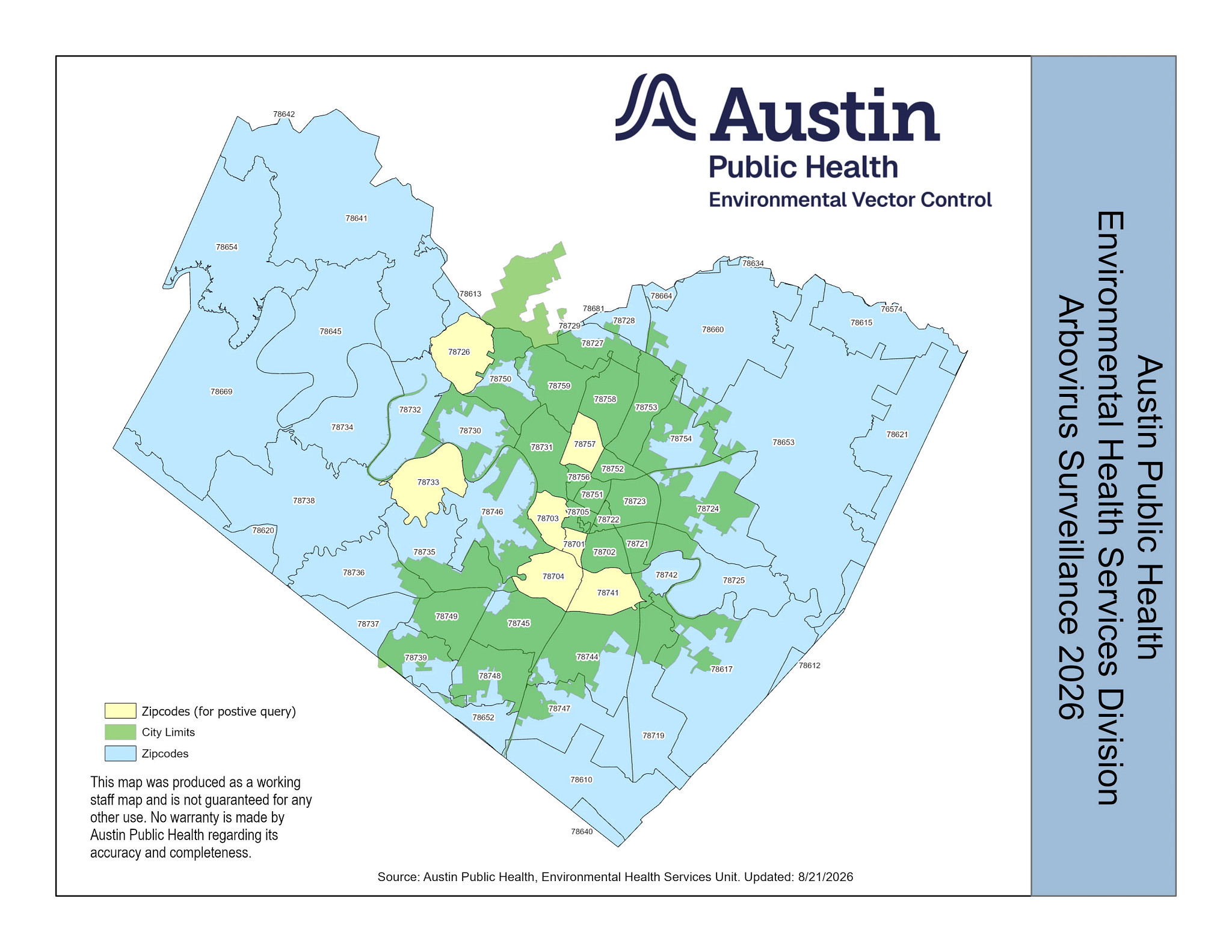
Attention: In 2026, mosquito pools (group of mosquitos collected) which have tested positive for West Nile Virus have not been found. APH Environmental Health Services Division will increase surveillance activities and post awareness signs/flyers in areas where these mosquitos are found.

Arbovirus Surveillance Map

Mosquitoes are present in Central Texas year-round, but the population is largest and most active from May through November. During this period, Austin Public Health monitors the population and tests for mosquito-borne viruses. Those that carry West Nile Virus (WNV) are of particular concern.

Mosquito Prevention

Mosquitoes are among the most important insect pests affecting the health of people. They are not just annoying; they can also transmit many diseases. A rainy spring proceeded by a mild winter, can lead to an active mosquito season.

Mosquitoes are present in Central Texas year-round, but the population is largest and most active from May through November. During this period, Austin Public Health monitors the population and tests for mosquito-borne viruses. Those that carry West Nile Virus (WNV) are of particular concern. In 2023 one West Nile virus death and three probable West Nile virus cases were reported in Austin-Travis County.

Symptoms

Most people who are infected with the West Nile Virus will not get sick. However, it is estimated that 20% of people who become infected will develop West Nile fever with mild flu-like symptoms, including fever, headache and body aches, a skin rash on the trunk of the body, and swollen lymph glands.

About one in 150 people infected with WNV will develop severe illness. Those older than 50 are at higher risk for severe disease. The severe symptoms can include high fever, headache, neck stiffness, stupor, disorientation, coma, tremors, convulsions, muscle weakness, vision loss, numbness, and paralysis.

Symptoms can last for as short as a few days, or may last several weeks, and neurological effects may be permanent.  Read more about symptoms from the Centers for Disease Control and Prevention (CDC).

Prevention

The most important way to prevent WNV is to reduce the number of mosquitos where people work and play.  Mosquitoes can only breed in standing water, and it can be in as little as one teaspoon. By draining all sources of standing water in and around your property, you reduce the number of places mosquitoes can lay their eggs and breed.

Using insect repellents and wearing protective clothing is the best way to prevent getting bitten by mosquitoes.

Ways to eliminate mosquito breeding sites
  • Reduce standing water around your home and neighborhood (including plant saucers, toys, buckets, and clogged gutters)
  • Replace water at least once a week in pet dishes and birdbaths
  • Repair leaky faucets and pipes
  • Keep window and door screens in good repair
  • Carefully screen rainwater harvesting cisterns to exclude mosquitos
  • Use “mosquito dunks” (Bacillus thuringiensis israeliensis)  to reduce mosquitos in rain barrels and permanent bodies of water. These products slowly release a biological larvicide that kills the pest
Guides

Rodents

Rodents, particularly rats, are responsible for a substantial amount of property damage and may carry diseases such as Murine typhus, plague, salmonellosis, trichinosis, leptospirosis, and rat-bite fever. If you notice a rodent activity in your area, please let us know by submitting a report:

-> Report a problem with rodents | City of Austin Services | AustinTexas.gov

Conditions like tall grass, accumulated trash, or debris can create environments where rodents live. If you see a possible code violation contributing to a rodent issue, report it to 3-1-1:

-> Austin 3-1-1 | City of Austin | AustinTexas.gov


Bees and Stinging Insects

City Ordinance Chapter 3-6 outlines the requirements for maintaining and managing bee colonies within Austin city limits. These regulations apply only to managed colonies and do not cover wild bee colonies that establish themselves in natural, protected spaces, such as tree hollows, tree stumps, or other locations not typically used for beekeeping.

-> To report a Bee Ordinance violation, contact 3-1-1 or visit Austin 3-1-1 | City of Austin | AustinTexas.gov.

The City of Austin supports the safe removal and relocation of bees whenever possible, rather than eradication. Due to state regulations, the City does not provide bee removal, relocation, or eradication services, nor do we maintain or endorse a list of service providers.

-> For bee removal services, please visit the Texas Apiary Inspection Service.


Bats

Austin houses the largest urban bat colony in North America. While bats contribute greatly to our ecosystem, it is important to be safe when encountering them. For information about potential rabies exposure see About Rabies | Rabies | CDC.


Contact Information

If you need assistance, we're here to help. Use the contact us form or reach us by phone, email, or in person at the address below. You can also view a map of our location for easy directions.

  • Phone: (512) 978-0300 and select option 5.
  • Email: ehsd.service@austintexas.gov
  • Physical Address: Environmental Health Services, 1520 Rutherford Ln, Bldg. 1 Ste 205, Austin, TX 78754.

Have Feedback?

We welcome your feedback and use it to improve our services. Please share your experience through the online survey below. If you need to address a concern or request a second opinion about an inspection result or complaint, contact us at 512-978-0300 between 7:45 a.m. and 4:45 p.m., Monday through Friday.

--> Feedback Survey: Austin Public Health Environmental Health Services


To return to our Environmental Health Services Division page, visit Environmental Health Services | Austin Public Health | AustinTexas.gov.