
Living Streets
Living Streets envisions local streets as places where communities can walk, bike, gather, and connect. The program offers residents a set of options to activate neighborhood streets and create opportunities for safe community-building throughout the city. See the active Living Streets installations and their details.
Program Values
- Equity: Living Streets activations are located in socially vulnerable areas, as defined by the City’s Equity Analysis Zones.
- Neighborhood support: A high percentage of residents living along proposed Living Street activations support them.
- Need for recreational space: Living Streets activations are located in areas with few parks.
- Neighborhood connections: Living Streets activations help connect to destinations like parks, libraries, and cultural sites.
- Need for multimodal infrastructure: Living Streets activations help create safer walking conditions in areas with incomplete sidewalks.

One-time closures of a single block to allow residents to hold small, locally-focused gatherings.
Neighborhood Block Parties
Neighborhood Block Parties (NBPs) are a fun, easy way to build community and get to know your neighbors. Neighborhood Block Parties give neighbors a chance to connect, enjoy the public realm of the street, share information, and celebrate events together. The program allows residents to temporarily close a street for up to 24 hours and hold parties to connect with their neighbors.
The City of Austin encourages residents and neighborhood groups to organize block parties on their nearby residential streets through the program application process. An adult monitor must be stationed at both ends of the street at the closures at all times. The Neighborhood Block Party application fee is $55.
- NBP Eligibility
A block party:
- Is open to all residents
- Is a one-time closure of a residential street
- Does not include vendors (food trucks are allowed on private property)
- Does not include alcohol sales
To be eligible for the Neighborhood Block Party Program, a street must:
- Be a local road (Level 1 street or lower)
- Be at least 15 feet in width
- Be a full, single block that:
- Does not include intersections
- Can be closed at each cross street (is not a midblock closure)
- Be a residential street of primarily single-family/duplex homes. Streets with multifamily buildings, schools, places of worship and commercial businesses have special rules and will be considered on a case-by-case basis.
- Receive support from at least 60% of the households along the street. 100% of the block must be notified.
- Submit an application at least 15 calendar days prior to the event
An eligible Neighborhood Block Party must not:
- Affect a traffic signal
- Affect a transit route
- Have paid parking on either side
- Intersect a Level 4 street or higher (If a block party would intersection a Level 3 street, it will be evaluated on a case-by-case basis.)
See what streets are expected to meet the viability requirements.

Space for people to walk, bike, roll, exercise, and build community within the public right-of-way by discouraging motor vehicle traffic.
Healthy Streets
Like other cities around the globe, Austin implemented an initial version of its Healthy Streets Program in 2020 in response to the COVID-19 pandemic to provide more space for people to walk, bike, and exercise outdoors while maintaining social distance. Today, Austin continues to see its local streets as places for more than just driving, and the Healthy Streets Program continues to provide space for other modes of transportation at all times of day.
Through the City’s resident-led version of the Healthy Streets Program, Austinites across the city will have the opportunity to apply for a Healthy Street spanning 3-4 blocks on a local street in their neighborhood. After selecting resident-led applications for implementation, City staff will install and maintain semi-permanent equipment to discourage motor vehicle traffic and provide more space for walking, biking, and rolling.
- Healthy Street Eligibility
A potential Healthy Street must:
- Be a local road (Level 1 street or lower)
- Be approximately 25 to 40 feet wide (Streets outside of this range will be considered on a case-by-case basis)
- Be a residential street (90% or more residential). Streets with multifamily buildings will be considered on a case-by-case basis. If there is a school or place of worship on the block, they must approve the equipment.
- Receive support from at least 60% of the households along the corridor
To be eligible for the Healthy Streets Program, streets must not:
- Connect directly to a Level 4 street or higher (If a Healthy Street would intersection a Level 3 Street, it will be evaluated on a case-by-case basis).
- Affect a traffic signal
- Affect a transit route
See what streets are expected to meet the viability requirements.

Space for people of all ages to gather and play by partially closing a single block to motor vehicle traffic for a few hours per day, several days per week.
Play Streets
Austin’s Play Streets Program aims to transform our local streets into places where families can meet and kids can play safely with minimal vehicular traffic. The Play Streets Program allows residents to close a single block to most motor vehicle traffic on up to 3 days a week, for a total of up to 12 hours per week. After applying and being selected for the program, residents will receive equipment, such as barricades and signs, from the City.
Applicants and their neighbors are responsible for
- Setting up - setting up and taking down the barricades at the assigned times.
- Monitoring – when the barricades are set up, there needs to be an adult present to move the barricades for local residents, their guests, their gardeners, the mail person, etc.
- Storing the barricades – the barricades must be stored on private property.
We recommend applicants start with selecting a total of 6 hours per week for a Play Street. If the applicant wants additional hours after the activation has been installed, the times can be adjusted.
Play Streets will remain open to traffic from residents, their guests, deliveries, emergency response, etc.
- Play Streets Eligibility
Eligible Play Streets must:
- Be a local road (Level 1 street or lower)
- Be approximately 25 to 40 feet wide
- Be a residential street (90% or more residential). Streets with multifamily buildings will be considered on a case-by-case basis. If there is a school or place of worship on the block, they must approve the equipment.
- Receive support from at least 60% of the households along the block
A Play Street must not:
- Connect directly to a Level 4 street or higher (If a Play Street would intersection a Level 3 Street, it will be evaluated on a case-by-case basis).
- Encompass an intersection that has more than 3 legs
- Affect a traffic signal
- Affect a transit route
- Have paid parking on either side
See what streets are expected to meet the viability requirements.
Recent Program Improvements
In response to community feedback, Living Streets staff are working to improve the Neighborhood Block Party, Healthy Streets and Play Streets Programs. After hearing community comments:
- The Block Party application will be easier and simpler for residents. This improvement was completed in October 2025.
Three Play Streets are currently testing an ‘Activity Zone’, which aims to reduce the burden on residents to move, monitor, and store the barricades, while still creating a safe area for people to gather and play.
- The Healthy Streets Program is rolling out equipment changes in two phases.
- Phase 1 reduces the number of pieces of equipment and replaces the ‘Local Traffic Only’ signs with yellow bicycle-pedestrian warning signs. This improvement was completed in December 2025.
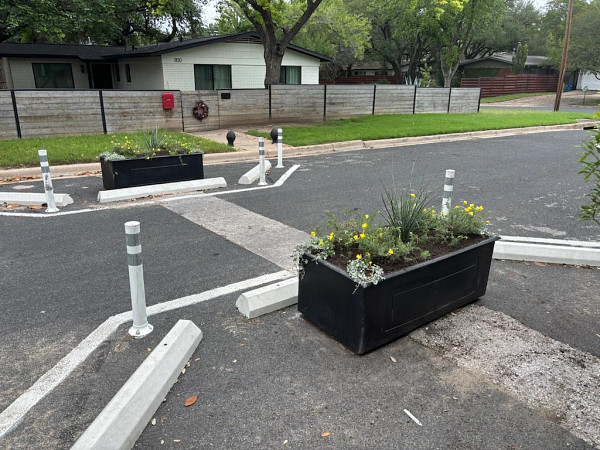
- Phase 2 aims to improve the equipment to align with community feedback and enhance Healthy Street safety, aesthetics, and maintenance efficiency. The orange cones and barrels will be replaced with planters, parking stops, flexible delineators and other small equipment. This equipment will be piloted on the following Healthy Streets in Spring 2026:
- Hyde Park
- Navasota
- Wooten
- Harris Park
- South Austin
Frequently Asked Questions
- How was Living Streets initiated?
The Living Streets Program, outlined in Resolution No. 20211021-027, was adopted by Austin City Council on October 21, 2021.
- How will getting to my home or business work? Can I have guests and take deliveries?
All local traffic for residents, including guests and deliveries, will be maintained.
- How will emergency vehicles get to my home or business?
Emergency access will be maintained at all times. Emergency responders have been made aware of the equipment.
- How will my trash and recycling be collected, and how will my mail and packages be delivered?
All normal street services, such as trash, recycling, mail, and deliveries, will be maintained.
- Am I allowed to relocate the equipment if it’s in front of my house?
No, unfortunately, the equipment's location is important to the safety of the Living Streets activation. The location of the equipment has been approved by the City's licensed engineers and is not to be moved from its place on the street.
- Can I have a bounce house at my Neighborhood Block Party?
Bounce houses and similar inflatable structures should be on private property and should not block any part of the street or sidewalks.
- Can I put up tents at my Block Party?
You can have temporary (non-air-inflated) tents in the closure if the following conditions are met:
- You maintain the emergency/local access lane (see Step 5 above)
- Each tent does not exceed 10' x 10'
- The total square footage of all tents does not exceed:
- 700 sq ft – If all tents do not have sidewalls
- 400 sq ft – If any tent has sidewalls
- Can I have music at my Block Party?
Yes. Amplified sound is allowed between 10 a.m. and 10 p.m and is limited to 75 decibels.
- How were these streets selected?
Healthy Streets, Play Streets, and Neighborhood Block Parties have three main goals:
- Provide a place for people of all ages to play and recreate in the public right-of-way.
- Create stronger community ties among neighbors, foster residents’ sense of place in their neighborhoods, and bring social interaction to the public right-of-way.
- Help provide safe, non-car-focused mobility connections to important destinations so that people feel more comfortable walking, biking, and rolling to where they need to go.
To achieve these goals, residents can apply for the program, and city staff will review applications for their potential to provide social and recreational space within the public right-of-way. Living Streets activations work best on low-volume, low-speed residential streets. These considerations, along with an equity analysis and the percentage of resident support for the activation, determine which streets are selected.
- How will Living Streets activations be monitored and maintained?
Austin Transportation and Public Works will monitor the activations. Resident Living Streets Ambassadors will also assist with observations and maintenance. If you are interested in becoming a Living Street Ambassador or would like to report an issue, please email us at LivingStreets@AustinTexas.gov.
- How long will a Living Street activation be in place?
The duration of a Living Street activation depends on the type of activation. Neighborhood block parties are one-time events that last 24 hours or less. Play Streets and Healthy Streets both last 3-6 months, depending on the application. Play Streets are set up and taken down at predetermined times during the week, but for no more than 3 days and no more than 12 hours in total. Healthy Streets are always set up, 24 hours a day, for the duration of the activation.
- How does a Living Streets activation affect parking?
Parking is allowed and unaffected by Living Streets activations. Living Streets is not a parking program, and does not bar anyone from using the street to park, drop-off, pick-up, etc
- How can I share concerns about a Living Streets activation?
Residents are welcome to share concerns about a Living Streets activation at any time. If you’d like the City to review an activation, we ask that you gather support from at least 60% of the parcels included in the original activation area. This is the same level of neighborhood support required when an activation is first installed.
To start the review process or discuss concerns, please email LivingStreets@austintexas.gov. Staff will walk you through the steps and provide additional information.
- How can I get involved and help with Living Streets?
There are a variety of ways you can get involved to help make the Living Streets Program successful.
- Call 3-1-1 to report damaged or missing traffic control devices, such as cones, barricades or signage.
- Sign up to be a Living Streets Ambassador: Street Ambassadors will be Austin Transportation and Public Works’ eyes and ears on the street, helping monitor barricade placement, report issues, and keep neighbors and the City informed. Email LivingStreets@AustinTexas.gov to let us know you’re interested.
- Give us your feedback on Living Streets by emailing LivingStreets@AustinTexas.gov
- Spread the word! Tell your friends and neighbors about Living Streets. On social media, use the hashtag #LivingStreetsATX to share how you’re using Living Streets.
Related Programs
Through the Neighborhood Partnering Program, Austin residents can work together to enhance the places they live, work and play. More than 80 community-initiated projects have been completed since the program first launched in 2010.
The Office of Special Events manages right‑of‑way use for special events and filming, including streets, sidewalks, parking, and alleys. The division issues permits, assigns case managers, reviews traffic control plans, and supports mobility.
Through the Neighborhood Partnering Program, Austin residents can work together to enhance the places they live, work and play. More than 80 community-initiated projects have been completed since the program first launched in 2010.
The Office of Special Events manages right‑of‑way use for special events and filming, including streets, sidewalks, parking, and alleys. The division issues permits, assigns case managers, reviews traffic control plans, and supports mobility.
Through the Neighborhood Partnering Program, Austin residents can work together to enhance the places they live, work and play. More than 80 community-initiated projects have been completed since the program first launched in 2010.
The Safe Routes to School Program helps children choose active modes of transportation to get to school. We aim to make sure elementary and middle school students across Austin can walk, bike and roll safely.