
Asian American Resource Center Exhibits
AARC Home | Events | Exhibits | Rentals | Senior Program | Youth Program
The AARC’s Community Art Exhibit Program displays artworks year round that celebrate the diverse and dynamic cultural heritage, history, identity and creativity of Asian American Pacific Islanders. Exhibits are displayed on a quarterly schedule.
Current / Upcoming Exhibits and Programs
Lao Textiles: Connecting Threads through Time | On-View July 14 through September 30, 2026
The AARC Presents Lao Textiles: Connecting Threads through Time, on-view in the AARC's Display Cases. Exhibit Curator, Joanne Click, showcases a collection of Lao textiles and weaving implements purchased while living on the outskirts of Vientiane with her family, 50 years ago. This exhibit reflects Click's observations of the rhythms of daily family life that sustained this textile art form. With assistance from Dr. Palina Louangketh and her daughter Eleanor Click, Lao Textiles: Connecting Threads through Time explores the intersection of ancient art with human journeys, with threads weaving together migration and rootedness, innovations and traditions, creativity and collaboration, function and beauty, families and communities.
Exhibitor / Curator Bios
Joanne Click is a journalist and retired university administrator whose chance encounter with Lao textiles while living in Laos with her husband and newborn baby led her to pursue a Master’s degree in Cultural Anthropology at the University of Texas at Austin. In 1973-1974 she lived with her family in a home set amid rice paddies on the outskirts of Vientiane, the capital city of Laos. There, she became spellbound by the rich, pre-industrial tradition of Lao textile weaving. She learned alongside an experienced weaver who came to her home to tutor her on all the steps required to create cotton and silk textiles based on ancient traditional technology Lao ancestors practiced more than a thousand years ago. She was evacuated with her family to Thailand only a few months prior to the initial upheaval of many Lao families who sought refuge in the United States. Over the past 50 years her interest in the beauty and creativity of Lao textiles has been interwoven with the life experiences of families she knew in Laos and their human journeys as they, too, sought the need to belong.
Dr. Palina Louangketh, founder and CEO/Executive Director of the Idaho Museum of International Diaspora is passionate about connecting communities to cultures of the world through creative storytelling platforms. Her family’s harrowing refugee journey to the U.S. resulting from the American Secret War in Laos inspired her vision to honor and elevate the human journey on a global scale. Additionally, she was one of three from the public ever invited to an exclusive private tour of the CIA Museum at CIA Headquarters, teaches organizational leadership and multicultural studies at Boise State University, and received the prestigious Fulbright Specialist Award in 2025.
The Mesh Threshold | A Solo Exhibition by Swathi Konduri | On-View July 14 through September 30, 2026
The AARC presents The Mesh Threshold | A Solo Exhibition by: Swathi Konduri, on-view in the Zen Garden Hallway. The Mesh Threshold is a multi-media exhibition centered around the blurring of public and private life on the streets of Indian cities, primarily Bangalore. Three people can be on the same block and still be in completely different spaces. One person could step out their front door and onto their "porch," the sidewalk. One person may be rolling by with their fruit cart, at work on the sidewalk. One person may be catching up with a friend at "their" favorite spot, the sidewalk. Street vendors are the best example of this: their workplace is also their living room, their social life, their stage. Jane Jacobs coined the term "eyes on the street" — the idea that a neighborhood's safety and liveliness comes from people who are simply present and paying attention.
Artist Bio / Statement
Born to parents from Hyderabad and Bangalore, I have spent my life moving between both worlds with different kinds of intimate access, comfort, and distance. Cross-cultural research has found that loneliness scales with individualism — the American street is a good illustration of why. Orderly, with concrete boundaries, and moving fast enough that no one spills into anyone else's life. These photographs capture what the orderliness misses: moments where public and private blur, where the street doubles as a living room and where you have no choice but to interact with the person two inches next to you.
Photography captured these scenes in real time while painting became the meditative counterpart, a way of sitting with an image long enough to understand why it struck me. In a world that prioritizes sleekness and speed, this series is an argument for the slower interaction; the kind that makes you feel like you just ran into a friend and makes you feel a little less alone.
Interested in exhibiting at the AARC or leading a creative workshop?
Community Exhibits Program: Our Community Exhibits Program rotates exhibits on a seasonal basis. Exhibits are selected through our annual open call for artists and curators. If you are interested in exhibiting at the AARC please stay tuned to our social media, website, and newsletter, where we will announce any available opportunities to submit exhibit proposals for our Community Exhibits Program. We do not review any exhibit proposals or art portfolios outside of our open call submission period.
Creative Workshop Program: If you are an artist or creative interested in leading a workshop with us, please contact the AARC's general email at aarc@austintexas.gov.
Permanent and Semi-Permanent Installations
- Lotus
Lotus by Sunyong Chung and Philippe Klinefelter, 2013
granite, handmade ceramic tiles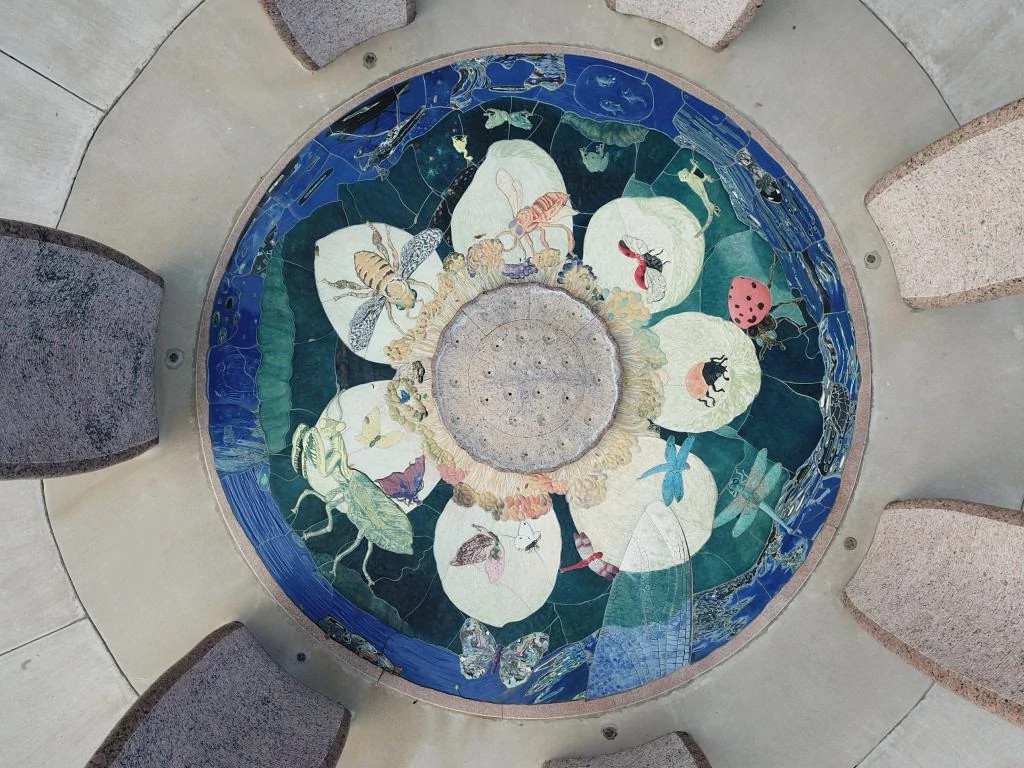
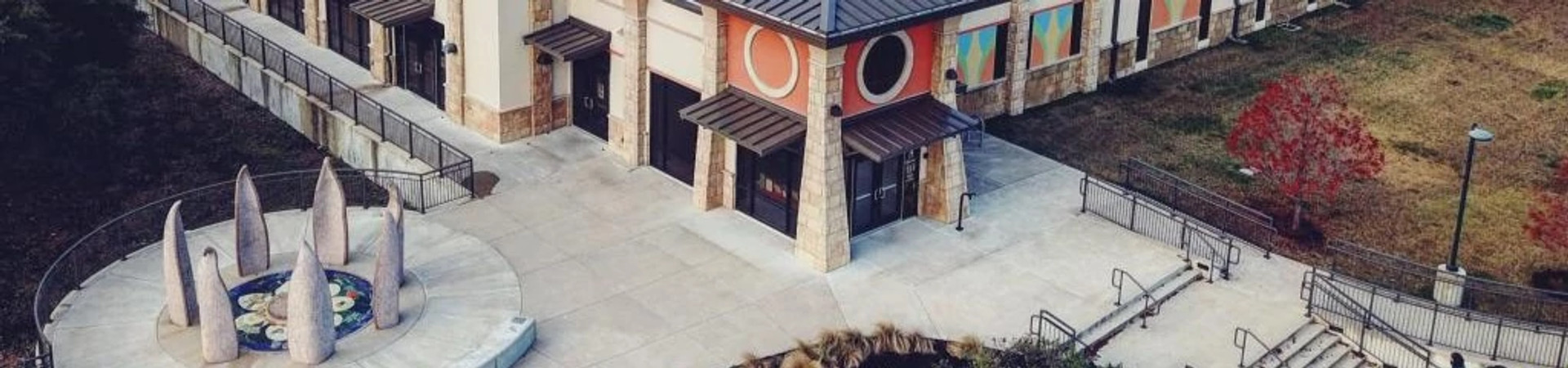
Lotus is a large site specific sculpture created by Art in Public Places commissioned artists Sunyong Chung and Philippe Klinefelter for the Asian American Resource Center (AARC), and is located in the entrance plaza overlooking heritage live oaks.
Chung created an intricate and lively 12’ diameter mosaic of a lotus, made of hand-colored and hand-crafted dimensional tiles, which Klinefelter surrounded with seven 9’ tall hand-carved granite “petals” gracefully reaching toward the sky. Klinefelter also carved the lotus’s seed pod at the center of the mosaic from granite, which doubles as a gently flowing fountain. According to feng shui principles, the placement of the fountain near the AARC entrance creates positive chi, or energy, for the building. The lotus, native to Asia, was chosen as inspiration for the sculpture because of its symbolic attributes of harmony, purification and healing.
- Prayer Phone
Prayer Phone | Semi-Permanent Art Installation
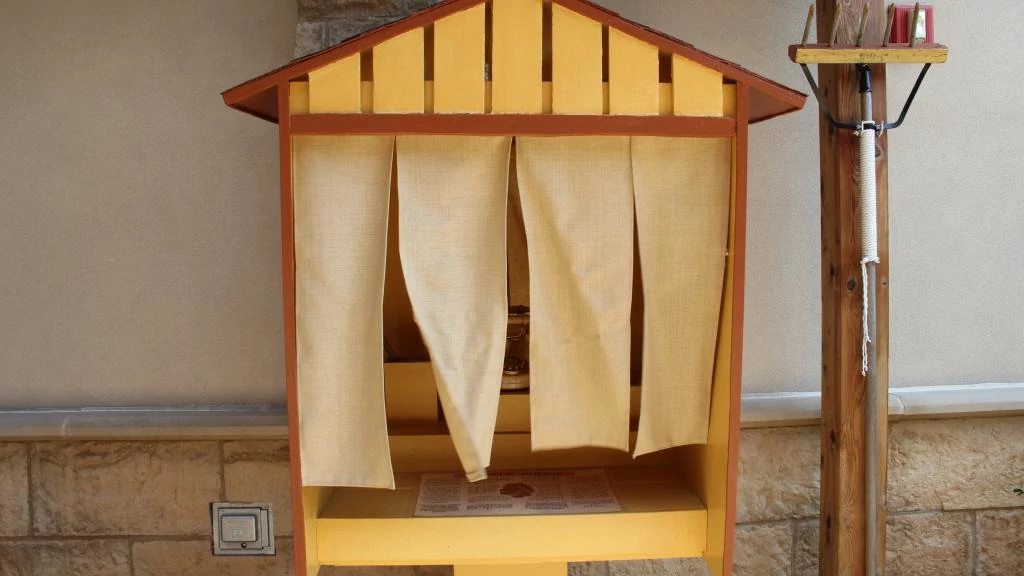
Prayer Phone, a handmade altar with a disconnected phone, is an invitation to the public to “call” their deceased loved ones while giving offerings and prayers. This project reflects a common custom of many Asian traditions: commemorating ancestors and venerating the spirit world.
Two essential elements compose this installation. The old fashioned phone is a symbolic artifact that represents humanity’s desire to connect and communicate with others. Its historic form evokes passage of time. By contrast, the spiritual act of lighting incense symbolizes the following: sacredness when the element of air is ignited, purification of the environment’s energy, and blessings in return for offerings. These two elements combine to help connect the earthly to the heavens.
This project is inspired by an episode of This American Life featuring stories about Telephone of the Wind in Otsuchi Town, a small seaside town in northeastern Japan. An iconic English telephone phone booth connected to nowhere was repurposed, and people began “calling” family members lost during the tsunami caused by the 2011 Great Japan Earthquake. Telephone of the Wind became a public space for people to grieve for their lost loved ones. In response, Prayer Phone shares in the deep tradition of respecting spirits and coexisting with entities beyond the physical realm, as well as providing a physical space and an outlet to feel connected with the departed.
Past Exhibits
- Past 2026 Exhibits
Migration and Integration, curated by Mai Deguchi, featuring five Asian Texan artists: Carme Pena, Ashley Adams, Emily Weerts, Evie Thompson, and Anna Pham
Stories of Home: A Photovoice Project, developed by AARC staff with contributions by AARC Senior Program participants
Ancestral Visions by Sandeep Chandran
Diaspora Offering by Allen Zewen Yu and Sun-Jue Shin
- Past 2025 Exhibits
Peelander-Yellow: Let's Play on Planet-Yellow!!!
Mamie Raynaud: Chinatown in Three Acts
Rooted: Central Texan Artists in the Asian Diaspora
Reflections: Patchworks of Asian America
Tiffany Heng-Hui Lee: Elements Connected
Chie Endo x promqueen: Untangling: AANHPI Intergenerational Dialogues
Barnuevo Velasco (curator): Golden Years Weighing Philippine Martial Law 1972-1981
- Past 2024 Exhibits
Saffron Creative House: Artistic Redirection
Kelly Lan, Bo Feng Lin: Kiss Papercuts Goodbye
Photo-Voice: Imagining an Age-Friendly Austin
- Past 2023 Exhibits
Jae-Eun Suh's "Ensemble Archives"
Finding Creativity in Resistance: The Legacy of Silk Club
Perlas Ng Austin: A Celebration of the Central Texas Filipino Community Through the Arts
- Past 2021 - 2022 Exhibits
ArtsResponders: Social Practice Responds to COVID-19 Featuring Lizzie Chen and Kengo
Tradition's Rebirth in Modern Austin
Creative Highlights Video Series
- Past AARC Exhibits
Colonized Women: Reclaiming Our Indigenous Roots
Reinventions, A Senior Art Show
Page last updated: June 24, 2026